
You Said Yes to a Friend. Now Say the Price.
By Sonam Patel · · 7 min read
A contractor asked Reddit whether he was wrong to hold out for a deposit before restoring a friend's flooded suite. He had already given her three free days. How to name the price before the first day.
What happened
A contractor posted in the r/AITAH subreddit this week with a problem that started as a favor. His friend rents a basement suite that flooded with raw sewage about six weeks before he wrote. He went over and did the first three days himself: cleaning, assessing the damage, and running turbine fans and dehumidifiers to keep mold from taking hold. He did that for her and for her landlord.
The landlord lives in another province and, in the poster's account, went quiet for weeks. The poster used to run a renovation business, closed it about a decade ago, and had recently felt like picking up tools again, so he wrote a quote for the remaining work, seven or eight days of it, priced well below market. The quote said plainly that he needed a deposit, "as I cannot afford to carry material or disposal costs for any length of time under my current circumstances."
The landlord accepted, then went two weeks without sending one, and did not answer when he asked about it three times. His friend, living in a wrecked suite, began pressing him to start anyway. He says her position was that she would bring her brother in from out of province, that she had no intention of paying him for his labor, and that she wanted to be reimbursed for materials she had bought. She stopped speaking to him, and two of her brothers started the work without the landlord's approval.
TwistedSifter reported the thread on November 7, 2026. Only his side of it is in the post, and the tenancy questions belong to her and to the landlord.
Why a friend is harder than a client
Look at the order of events. Three days of skilled labor went out before anyone said the word deposit. That is how these jobs usually start: something floods, someone you know is standing in it, and you show up because you can. The paid portion arrives later, and by then the terms are being negotiated in a hallway with a fan running.
Three things get tangled after that. You are doing the work for one person and being paid by another, so your friend is not your client but is the one watching the calendar. You discounted the rate because you know them, and a discount given out of affection is hard to defend later on a spreadsheet. And the urgency is real, which makes every ordinary professional condition, like a deposit, feel like you are being difficult on purpose.
None of that makes the deposit wrong. It makes the conversation too late.
Say the price before the first day
Four parts, in this order: the number, what it covers, when the work starts, and why the deposit exists.
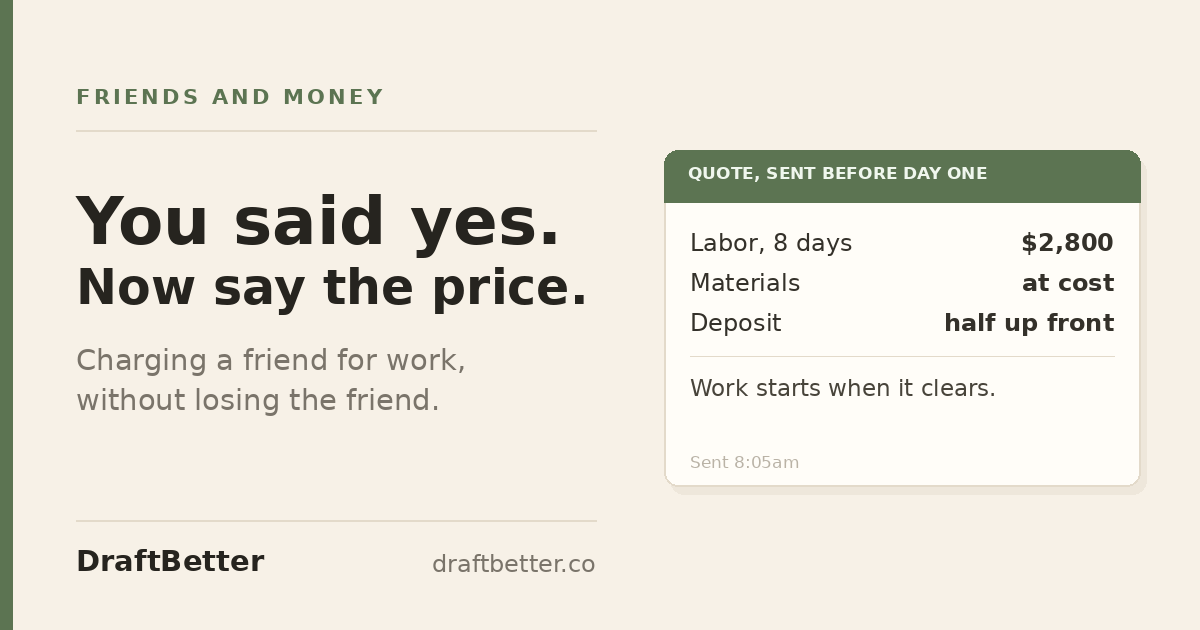
"Quote: eight days of labor at $2,800, materials at cost with receipts, and half up front before I order anything. I can start the Tuesday after the deposit clears. The deposit is not me doubting you. I cannot float material and disposal costs for a month on my own."
Your numbers will differ and the shape holds. The condition sits in the middle of the message, not at the end as an apology. "I can start after the deposit clears" is a schedule. "I hope that's okay" is an invitation to negotiate it away.
If you are not writing a document, the same four parts work as a text.
"Quick scope so we are on the same page: two weekends of work, $600, you cover materials, and I can start the weekend after next. If that works, I will book it in."
Charging a friend without the speech
You do not need a speech about boundaries. You need one clear sentence, and then to get on with the job.
Discount the scope, not the rate. One free Saturday reads as generous. Cutting your rate in half reads as your new rate, and that is the number people remember.
Say what free looks like, if you want to give something. "I can give you a Saturday to help get the drywall out" is specific and finite. "I'll help however I can" is neither, and it is how a favor turns into eight days.
Skip the apology. Charging for skilled work is not a confession. "That is my price" does not need a cushion.
When they ask you to do it for free
Sometimes the ask is direct. Answer the part you can do, and name the part you cannot.
"I want your place livable again, and I can't do eight days of work unpaid. What I can do is walk your landlord through the scope on a call so this moves, and give you two names if you want other quotes."
That is hard to argue with, because it offers something real. It also puts the pressure back where it belongs, which in this story was the person holding the deposit.
If you are the friend doing the hiring
The mirror version matters too. If someone you know is doing the work, the kind thing is to take the terms at face value.
Pay the deposit without making them ask twice. Do not push them to start before the money lands, even when the delay is maddening and the delay is not theirs. If they gave you a discount, thank them once, and do not ask for the next one.
"I know the landlord is the holdup and I'm not going to keep chasing you about it. Tell me what you need from my side and I'll do that."
When the mess is not yours
In the thread, the real fight was between the friend and a landlord in another province. The poster's mistake was not the deposit. It was staying in the middle of a triangle where he had no authority and plenty of exposure.
You can say what you will do, what it costs, and when you can start. What someone else's landlord decides, what happens to a lease, and whether unapproved work creates a problem are questions with real consequences, and they are not answered by the person holding the hammer. Point those questions at the people whose job they are, and say so kindly.
What not to put in the message
"Just pay me whatever feels fair." It sounds easygoing, and it hands the number to someone with every reason to aim low.
"I'll do it as a favor" when it is not one. If you will resent it in week two, it is a job.
"Don't worry about the deposit." You are the one buying the materials.
"I can't believe you would ask me that." A real feeling and a bad sentence. Say the terms again instead.
An invoice that appears after the work. A price first mentioned at the end is not a price. It is an ambush, even when the number is fair.
Where it lands
The price was never the problem in this story. The missing sentence was. Three free days, a quote he wrote himself, and terms that existed in his head and in a document nobody had read out loud.
Work for people you know. Say the number before the first day, and say it in a way that leaves you both something to stand on when the job is done.
If the money in your situation is a shared bill rather than a rate, how to ask a neighbor to split a cost covers that version.
Not sure how to say the number without it landing badly? DraftBetter helps you find clearer words and explore how your message might come across before you send it. Start your message.
Ready to say it?
Describe your situation and DraftBetter will write the message, then show you how the other person is likely to read it.