
Your Neighbor Wants It Fixed. Who Pays?
By Sonam Patel · · 8 min read
A homeowner asked Reddit whether he would be out of line for asking his neighbor to help pay for removing a hive from his roof. The awkward part was never the money. Scripts for the ask, and what to do with a no.
What happened
A homeowner posted in the r/AITAH subreddit asking whether he would be out of line for asking his next-door neighbor to put money toward removing a beehive from his own house. He is 52 and lives alone. Jessica, the neighbor to his left, is 65. Her 19-year-old granddaughter has just moved in. Jessica has been stung once already, and she does not know whether her granddaughter is allergic.
The bees do not bother him. "The bees aren't affecting me in any way, shape, or form," he wrote. Jessica asked if he could have the hive removed. He got quotes: $700 to $1,000 for the simplest route if nothing goes wrong, and $1,200 for the option where the company handles everything in-house. Both mean cutting into his roof or his stucco.
TwistedSifter reported the thread and its figures on November 2, 2026. At the time he wrote the post, he had not asked her. His question was whether asking would make him the jerk.
The money is not the hard part
The arithmetic is easy. What makes this conversation difficult is that one person wants the work and the other person is being handed the bill for it.
Two ideas get mixed together here. Who is responsible for a repair is a question about ownership, local rules, and sometimes a lease, and the answer varies enough that guessing at it is a bad way to start. Whether you chip in is separate, and voluntary. A neighbor who offers to split a cost is being generous, not admitting fault, and a neighbor who declines is not admitting anything either. What you can control is how clear the ask sounds, and how easy it is to answer.
Why these asks go wrong
Asking for half of a number that does not exist yet. "Let's split it" before you have a quote is a guess with a dollar sign in front of it. Get the estimate first, then name the share.
Using the language of a bill. "You owe me half" arrives as a verdict, and people argue with verdicts. "Would you be willing to split it" is a question, and questions get answers.
Arguing about fault. The hive was there before the granddaughter, the tree was planted by the previous owner, the fence was leaning when you bought the place. The history is interesting, and it rarely changes what the fix costs. Stay in the present tense.
How to ask, in one message
Four things, in this order: the work, the real quote, the share you are proposing, and room for them to say no.
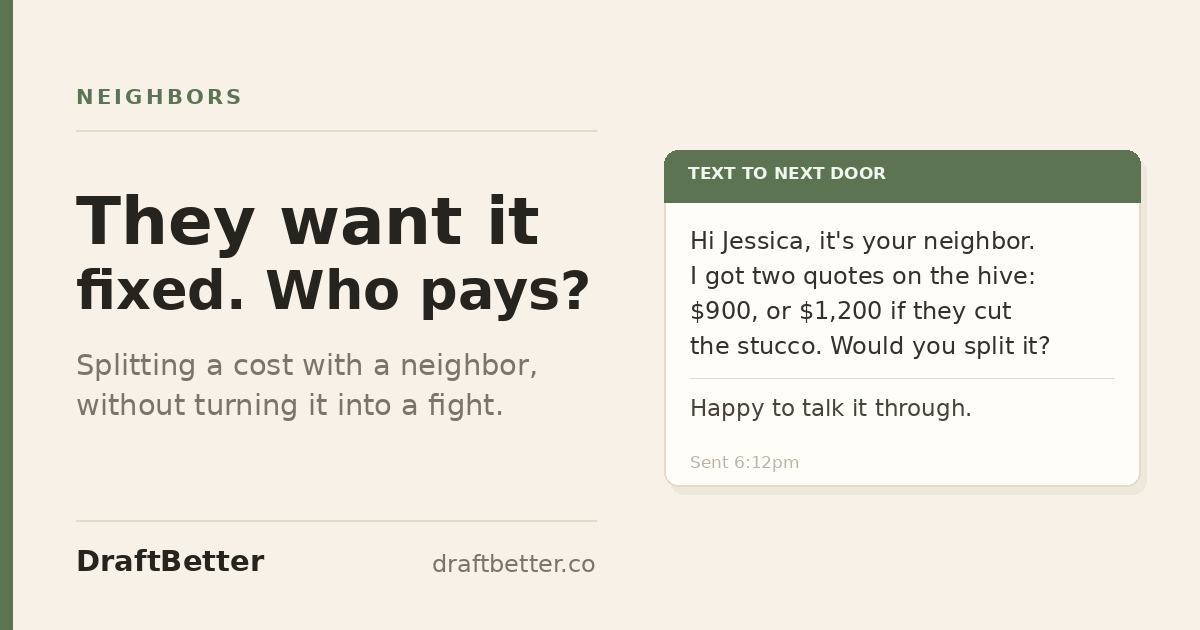
"Hi Jessica, it's Dan next door. I got two quotes on the hive. One is $900, and the other is $1,200 because they have to cut into the stucco. I'm not bothered by the bees, so I know this matters more on your side than mine. Would you be open to splitting it? Happy to talk it through if you want the details."
Every part of that is doing a job. "I'm not bothered by the bees" says whose concern this is without scoring a point about it. Two real numbers give her something to choose between instead of a feeling to react to. "Would you be open" leaves room for a no, which matters when the person answering lives twenty feet away.
The dollar amounts in the sample messages are placeholders, not estimates. Use your own quote, since prices vary by region and by how easy the job is to reach.
A split does not have to be half. You can offer to cover the basic version and ask for help with the version that does less damage to the house, or name the smaller number you can live with. A specific, modest ask is easier to answer than a general appeal to fairness.
If you would rather not put a figure in the first message, ask for the conversation instead.
"Hi Jessica, it's Dan next door. I had a company look at the hive on my roof, and the number is higher than I expected. Could we talk for five minutes this week? I'm not expecting you to cover all of it."
That version asks less of both of you, and it puts the hard part in person, where a shrug is easier to read than an unanswered text.
If the work is on their side and you want it done
This is the same conversation from the other chair, and here you lead with money rather than a request.
"Hi, it's Sam from number 12. The limb over my driveway is dropping branches on my car. I know it's your tree and you may not want to spend on it. If you're willing to have it cut, I'll pay half, and I can get the quote so it's one number for both of us."
You named the thing you want, you said you are paying, and you took on the work of finding a company. That last part matters more than the money for a lot of people.
A few things are worth checking before that message goes out. Tree work near a lot line is often covered by local rules and by whose trunk it is, so ask before a crew steps onto your neighbor's side, and check with your city, your landlord, or your HOA about what you may cut on your own. With bees, a beekeeper or a licensed removal service is a better bet than a can of spray, and it is worth asking whether they relocate the colony or remove it. Fences work the same way: some sit on the property line and some belong to one side, so find out which before you offer to split anything.
If they say no
A no is worth taking at face value, not because the answer never changes, but because pushing after a clear no is how a cost question turns into a long stretch of careful eye contact in the driveway.
You still have options. You can pay for it yourself and stop bringing it up. You can do the smaller version now, the one limb or the failing section of fence or the part you can reach. You can say that if things change, the offer stands. Pressing rarely brings the money back, and it does make the next conversation harder.
One caution about paying. If you decide to cover it, cover it, and then let it go. A payment that turns into a running tab is a payment you will both be reminded of later.
Put the agreement somewhere
After they agree, send one short message that repeats what you both just said: the company, the date, the total, and who pays what. Not because you expect a fight, but because two people remember a split differently two weeks later.
"Just so we both have it, the company quoted $900, they come Thursday the 12th, and we're each covering $450. Thanks for splitting this."
If you are the one being asked for money, the mirror version is worth holding: ask to see the estimate before anything is booked, and know what the work includes before you hand over a check. That is not suspicion. It is the same clarity you would want from any contractor.
What not to put in the message
"It's your responsibility." You may be right, you may be wrong, and either way it turns a request into a legal argument in a hallway.
"Fine, I'll just leave it then." It hands the problem back as a punishment instead of a decision, and it is the line people remember.
A deadline you invented. Saying the company needs an answer by Friday when it does not is a pressure you cannot take back.
Everything else they have done. The parking, the dog, the leaves in October. Bundling old grievances into a cost question makes the cost the smallest thing in the message.
A promise you have not checked. If you say the work will take a day, or that the damage will be minor, be sure that came from the company and not from you.
Where it usually lands
These conversations usually end in one of three places: they split it, they decline and you decide what to do alone, or they surprise you by offering more than you asked. The wording does not decide which one. It decides whether you can still borrow a ladder from each other afterward.
So: the work, the number, the share, the way out. One message, one clear question, and no scorekeeping while you wait.
If your problem is noise rather than money, what to write on a note about it is the same conversation with a smaller bill.
Not sure how the ask will land next door? DraftBetter helps you find clearer words and explore how your message might come across before you send it. Start your message.
Ready to say it?
Describe your situation and DraftBetter will write the message, then show you how the other person is likely to read it.